

80 Apps, One Device, Zero Patience
My field notes from Zebra Technologies' ZONE 2026 Customer Conference, and why tokenless, on-device AI is the most practical thing happening to retail’s frontline right now.

Join the #1 Indie Podcast Network for Retail as we cut through the clutter in retail strategy, innovation & leadership to help you maximize growth for your business. Subscribe to The Retail Razor Show podcast! Stay sharp. Stay human. Stay ahead!
Missed the last issue?
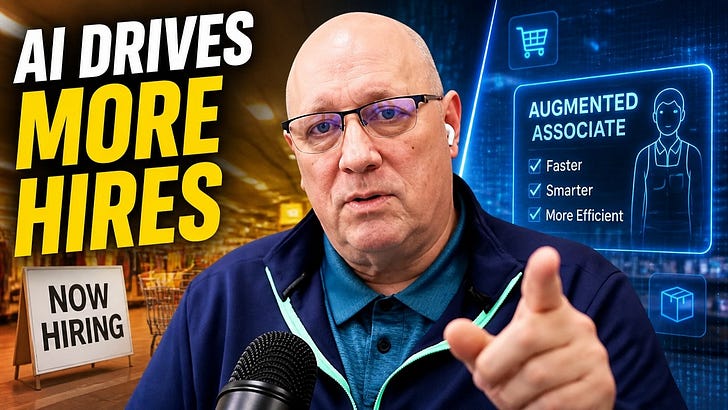
I have sat through a lot of conference sessions in the last two years, and they all run the same slide with a headline about AI coming for retail jobs. Casey and I have seen it enough times that we can mouth along. Then Greg Buzek pulled up the actual numbers, and the whole doom story fell apart in about ninety seconds.
I Went to Nashville Expecting a Device Story. I Got Something Better.
Picture a store associate holding a handheld with 80 apps loaded on it. They use about a dozen. The rest are digital clutter that somebody back in corporate was sure they needed. That picture sat in my head for two straight days in Nashville, and it’s still the cleanest way I know to explain what Zebra Technologies ZONE 2026 Customer Conference was really about.
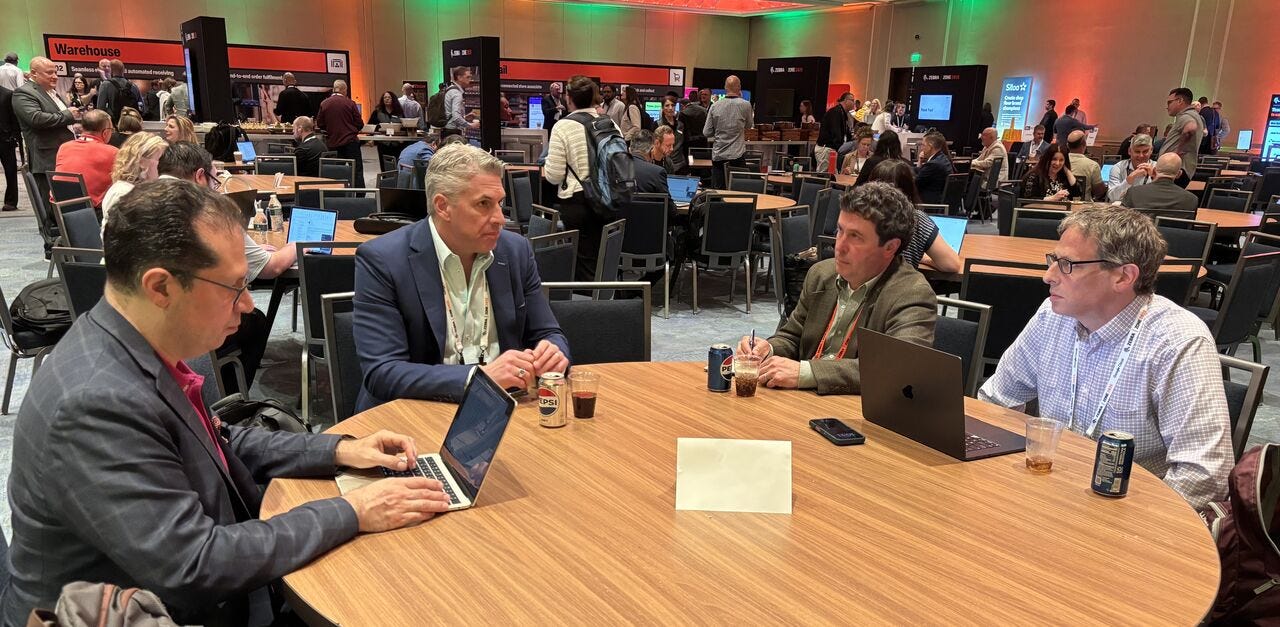
I was there as one of the media guests, two days of keynotes, demos, customer conversations, and two exclusive interviews I will point you to in a minute. I came home with a notebook full of session receipts and a pretty strong opinion about where AI for the frontline is actually heading. Here is the short version. Some of it you should hear in the guests’ own words, so I am holding a few things back so you have another reason to listen or watch the episode. It is a podcast after all!
Zebra quietly stopped telling a device story.
We all know Zebra from the handhelds and scanners in every store and warehouse you have ever walked through. The headline for me this year is that they are done being only a device company. They are telling a frontline platform story now, and they anchored it on three software launches.
Zebra Nucleus is a single pane of glass for configuring and managing every device they make, mobile computers, scanners, printers, RFID readers, all of it. Those used to live in three or four separate tools.
Workcloud IO is an integration and orchestration layer that connects to more than 250 enterprise apps and routes the right work to the right person.
Workcloud BI delivers role-based dashboards, so an associate, a store manager, and a regional director each see what they actually need and nothing they do not.
Management, orchestration, intelligence. Not the flashiest three words in tech, and that turned out to be the whole point.
The numbers that floored me.
Here’s the stat that stopped the room.
Retailers are loading frontline handhelds with 70 to 80 apps, and workers regularly use about a dozen. The 80/20 rule, alive and well, costing real money.
Suresh Menon, who runs the software business, put up a McKinsey figure on stage that frontline workers spend roughly 30% of their time just hunting for information they do not have. Then he said about half of all frontline errors trace back to someone not understanding a standard operating procedure. Read those two together and the conclusion writes itself.
This was never a hardware problem.
Giving people a nicer device was only ever part of the equation. The real job is letting people actually do their job.
Zebra’s answer is a super app they call Sync that covers something like 99% of what a frontline worker touches in a shift. Communication, tasks, scheduling, clock in and clock out, even micro-learning. All the things that used to be 70 or 80 separate icons, routed through one app the associate actually opens.
As somebody who has said for years that email is where information goes to die, I found that very easy to root for.
The through line that shows up on every conference stage…
The word I heard more than my own name.
Tokenless.
If I had a dollar for every time someone said it, running out of tokens, blowing the token budget, wanting to go tokenless, I could have bought a year of cloud tokens with the proceeds.
Zebra’s AI bet is on running things locally. The model is hosted on the device, the inference happens on the device, nothing makes a round trip to the cloud, so no tokens get consumed. The timing was almost too perfect, because the news headlines had just published had Uber and Microsoft both admitting they had to pull back on AI spend because token costs were torching their budgets.
Zebra walked on stage and basically asked, what if your AI bill was zero?
The part people miss is latency. Frontline work needs an answer in tens of milliseconds.
Think about how long you wait after you hit send on ChatGPT. A second, two, three. Now imagine you are the associate and a customer is standing right there counting those seconds. It feels like an eternity, and the meter is running the whole time. On-device AI just works in the flow of the moment, which for this kind of work matters more than almost anything else.
The surprise I did not see coming: language.
One executive shared that almost 68% of US frontline workers speak a language other than English at home, and that a single distribution center had 18 different languages on the floor.
Eighteen.
They also said nearly half of frontline mistakes can be traced back to a language miscommunication.
Zebra’s fix is real-time AI translation built right into the workflow, down to live voice, running on the device. I speak English, you hear Spanish, and back again. I had lunch with Erin Vigil from Burlington, a retailer with no e-commerce where every sale happens in the store, which makes the associate the entire show. She told me that translation feature was one of the biggest wins across their associate base and a no-brainer to switch on.
That’s what a practical use of AI looks like, and it does more than save a few minutes. It changes how it feels to show up for that job.
Two interviews you should actually hear.
I sat down with two Zebra leaders, and they make a great pair because they come at this from opposite ends.
Tom Bianculli is the CTO, the big-picture guy. His framing of pragmatic AI is the idea I keep coming back to. His favorite examples are not fantastical.
A nurse spends 25 to 30% of a shift on documentation, and ambient AI on the device hands roughly 20% of the workday back. Nobody went to nursing school to do paperwork.
A receiving dock where 40% of manifests show up with no barcode goes from typing every field by hand to snapping one photo that drops straight into SAP.
His tagline for all of it is “better every day,” and after two days I understood why.
James Poulton runs mobile computing, and he is delightfully opinionated. I opened by asking what is most overhyped in AI right now, and his answer is going to surprise a few people. I will let him say it in the episode, but the short tease is that he thinks the obvious thing everyone is chasing is the wrong tool for the frontline.
He has a great story about warehouses running for decades on a 25-word vocabulary, and he is the one who dropped the line Casey gave the quote of the episode to.
“AI is limited by your imagination, not by atoms.”
Hear the setup before that line lands. It’s better with the runway.
So what do I actually think?
Here is where I land. Every customer story at ZONE was the same shape underneath. A fixed labor pool meeting growing demand. You cannot hire 20% more people or pour 20% more concrete to fix that, so you give the people you already have the superpowers to do the work better and faster.
That is augmentation, and it’s the thread Casey and I have been pulling on this show for years.
The technology industry is finally catching up to the idea that your associate experience is your customer experience.
A futurist at the keynote, Jonathan Brill, had a metaphor I can’t shake. Two-thirds of an octopus’s neurons live in its arms, not its head, so the arms explore and decide on their own while the brain coordinates. Push the intelligence to the edge instead of hoarding it at headquarters. That is exactly what good frontline AI should do, and it changes who gets to make decisions in a store.
If I had to compress two days into one idea, it would be that consolidation is the new innovation. The win is not a shiny new feature. It’s taking a sprawling mess of apps and tools and collapsing it into one console and one experience a human can actually use. And the proof is in the small numbers. A second and a half per delivery. Four taps instead of eight. A two-minute training video instead of an hour in the back room.
Scale those tiny moments across millions of interactions and you get a real ROI, which is a far more honest case for AI than most of what gets shouted from a stage.
Pragmatic, on-device, augmentation over replacement. That is the version of retail AI I will keep betting on.
Why the store is your best training ground…
🔊Hear the whole thing.
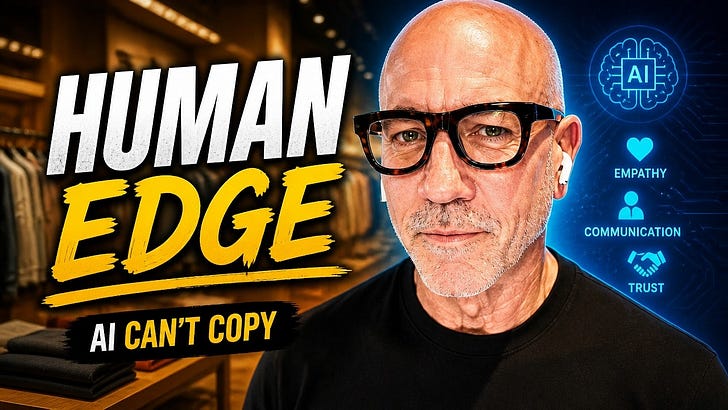
The Retail Razor Show, Season 6, Episode 8 BONUS episode: Pragmatic AI for Retail’s Frontline: Tokenless & On-Device
Find this episode on Apple Podcasts, Spotify, Goodpods, YouTube, or anywhere you listen to podcasts. Transcripts and guest info at retailrazor.com.


Your Turn.
Listen to the full bonus episode of The Retail Razor Show for both interviews and the four big takeaways. If you’re not subscribed yet, you’ll want to fix that — in a few weeks we have a three-part series going even deeper on the frontline with the National Restaurant Association.
Comment on this newsletter or join the conversation on LinkedIn!
Your insights may help shape the topics we explore next.
Until next time… Stay sharp. Stay human. Stay ahead!
Sincerely,
Ricardo Belmar
The Retail Razor Show
Thank You for Your Support!
We’re honored to be the #1 Indie Podcast Network for Retail on Goodpods having recently hit the #1 spot on the Top Weekly & Monthly Indie Business Podcast charts, plus the:
Top 4 podcasts in the Top Weekly Management Podcast charts
Top 4 podcasts in the Top Monthly Management Podcast charts
#1 podcast in the Top Weekly & Monthly Indie Careers Podcast charts
#1 podcast in the Top Weekly & Monthly Indie Marketing Podcastcharts
And we’re excited to have two podcasts ranking in the Top 20 Retail Management podcasts and a Top 5 Retail Careers podcast on Apple Podcasts!
We’d love your support to help us stay at the top with all our shows by giving us a five-star rating and review on Apple Podcasts, Goodpods, or Spotify.
The Retail Razor Show is part of the Retail Razor Podcast Network, alongside Retail Transformers, Blade to Greatness, and Data Blades. Find us at RetailRazor on LinkedIn, Bluesky, Threads, and Instagram. For a full transcript of this episode, visit our retailrazor.com website!